Sub-Total: $0.00
Celebrating 21st Birthdays in Fiji: A Cultural Tradition
In Fiji, turning 21 is not just a birthday it is a cultural declaration of adulthood. Families gather, communities show up, and a handcrafted key is placed into the hands of a young person to mark everything that comes next.
Celebrating 21st birthdays in Fiji is one of the most meaningful traditions in Pacific culture where the ceremony, the food, the faith, and the key itself are all deeply connected. We have worked with Fijian families across Australia, New Zealand, and the Pacific to create 21st birthday keys that honour this tradition, and every family we work with wants that meaning reflected in what they give.
The Meaning of 21 in Fijian Culture
While the legal age of adulthood in Fiji is 18, most Fijian parents do not see it that way. In their view, 21 is the real threshold — the age when a young person has finished school, stepped into work, and is ready to be counted as a full member of the family and community.
This is why the celebration carries such emotional weight. It is not a party for its own sake. It is the family’s formal recognition that their child has arrived. Speeches are made, tears are shed, and the 21st birthday key is presented with real ceremony not handed over casually, but given as a public statement of trust and readiness. If you want to understand how different cultures approach this moment, our guide on Samoan traditions shows how closely these Pacific milestones are shared.
The Family’s Role in the Celebration
Planning a Fijian 21st birthday is never a solo effort. The whole family and often the wider village comes together weeks in advance to organise the feast, the program, and the decorations. Every person has a role, whether that is cooking, setting up, or performing.
What makes this different from a standard birthday party is the shared ownership of the moment. The celebration belongs to everyone present, not just the person turning 21. Stories are told, advice is given publicly, and the birthday person is reminded warmly and formally of where they have come from and what is now expected of them.
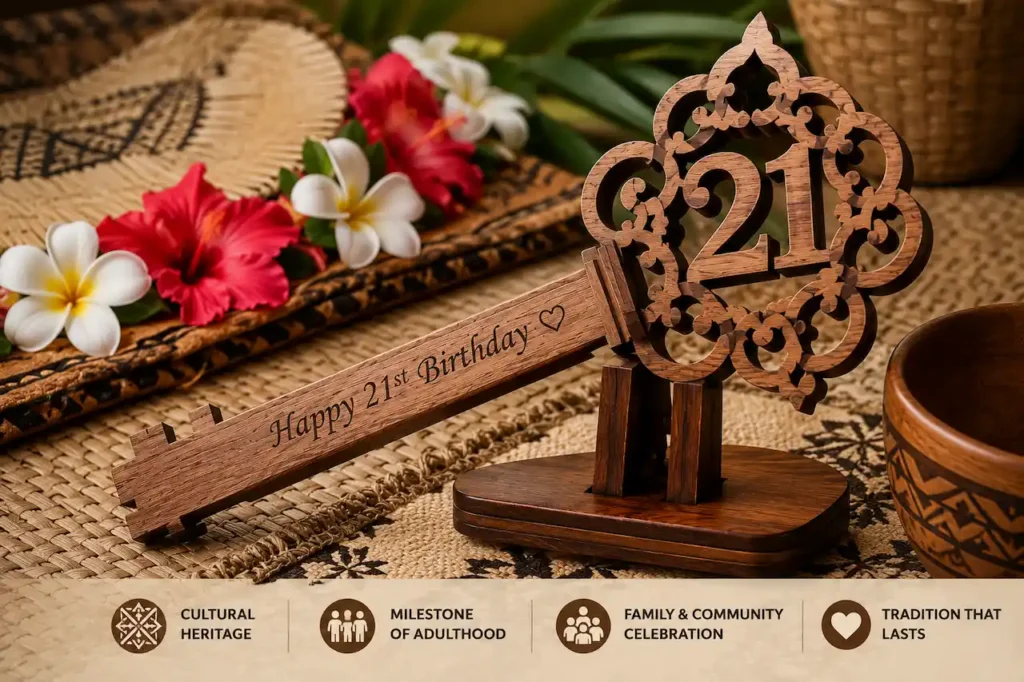
The centrepiece of it all is the key presentation. Parents or guardians hand a large decorative key to their child in front of the entire gathering often paired with a small gold key pendant. If you are starting to think about what kind of key fits this moment, our 21st birthday key ideas guide walks through the most meaningful options.
The Importance of the Church
Faith sits at the centre of Fijian life, and 21st birthday celebrations are no exception. A pastor or church elder is almost always invited to open the event with prayer and to bless the food before the feast begins. This is not a formality it reflects a genuine belief that turning 21 is a spiritual milestone as much as a social one.
We have seen this same tradition carried faithfully by Fijian families living in Australia, the UK, and across the Pacific. No matter where the celebration takes place, the church’s involvement stays.
Traditions and Culture
One of the things we admire most about Fijian families is how deliberately they keep their traditions alive, regardless of where they live. We have crafted 21st birthday keys for Fijian celebrations held in Brisbane, Sydney, Auckland, and London — and every one has been built around the same cultural touchstones: the lovo, the masi cloth, the church blessing, and the key ceremony.
Distance does not dilute the tradition. If anything, it strengthens it. For Fijian families living abroad, the 21st birthday celebration is one of the clearest ways they pass their culture to the next generation and a key with a masi design is one of the most meaningful ways to honour that at the celebration itself.
Traditional Clothing and Dance
The visual elements of a Fijian 21st are unmistakable. The birthday person wears a masi cloth skirt and a salusalu a handmade floral garland and is seated on a woven mat during the key presentation. In many families, the celebrant’s name is woven into a fan or printed directly onto the masi cloth as a permanent keepsake.
Dance performances follow. Family members perform both traditional and modern dances as an act of celebration and respect, and the crowd gifts the dancers with money or small presents throughout. It keeps the energy generous and communal exactly what a Fijian 21st is built to be.
Fijian Food for a Big Celebration
Food is never an afterthought at a Fijian 21st. The lovo an earth oven where meats, dalo (taro), and palusami (a coconut and taro dish) are slow-cooked over heated stones is the centrepiece of the feast. Fried fish in coconut milk is another staple, and kava is served ceremonially as the evening unfolds.
Because Fiji is a genuinely multicultural country, the table at most celebrations also includes Indian curries alongside Chinese-influenced dishes like chop suey and chow mein. The variety is not accidental it reflects the community exactly as it is, and it makes the feast one of the most memorable parts of the night.
Fijian-Inspired 21st Birthday Keys
The 21st birthday key is more than a gift it is the most lasting symbol of the entire celebration. We craft each key with designs that reflect what actually matters in Fijian life: family, faith, cultural heritage, and the transition into adult responsibility.
Every key we make is personalised. Whether that means engraving a name, incorporating a cultural motif, or working with a family to capture something specific about their story, we build each piece to be presented publicly and kept permanently. You can explore our full range of custom 21st birthday keys in Australia and find the design that fits the occasion.
Conclusion
The Fijian 21st birthday is a celebration built on three things: family, faith, and cultural pride. The 21st birthday key sits at the heart of it not because it is the most dramatic element, but because it is the one that endures. Long after the lovo has been eaten and the dances are done, the key stays.
If you are planning a Fijian 21st and want a key that reflects the weight of that moment, get in touch with us and we will help you create something worth keeping.
Why Choose Us
We create handcrafted 21st birthday keys built for Fijian celebrations and the families who take them seriously.
- Custom designs that incorporate Fijian cultural symbols — family, faith, and heritage
- Made from premium hardwood with engraving that holds its clarity for decades
- We work with families across Australia, New Zealand, and the Pacific
- Fast turnaround with personalised service — no generic catalogue pieces
- Every key is built to be presented, kept, and remembered
FAQs
What is the significance of the 21st birthday key in Fijian culture?
The key symbolises a young person’s readiness to take on adult responsibilities. It is presented by parents or guardians in front of the entire gathering as a formal and public recognition of the milestone.
Why do Fijians celebrate the 21st birthday instead of the 18th?
While 18 is the legal age of adulthood in Fiji, most families consider 21 the true threshold — the age by which a young person has completed school and is stepping fully into adult life.
What is a lovo and why is it served at a 21st birthday?
A lovo is an earth oven used to slow-cook meats, taro, and traditional Fijian dishes over heated stones. It is the centrepiece of the feast at most major Fijian celebrations, including 21st birthdays.
Can Fijian 21st birthday traditions be celebrated outside Fiji?
Absolutely — and many families do exactly that. Fijian communities across Australia, New Zealand, and the UK maintain the same traditions: the lovo, the church blessing, the masi clothing, and the key ceremony.
What should I look for in a Fijian 21st birthday key?
Look for a key that can be personalised with cultural symbols or the celebrant’s name, made from durable hardwood, and crafted with enough detail to reflect the seriousness of the occasion — not a generic off-the-shelf piece.
Disclaimer
The contents of this blog are for informational purposes only and are based on information sourced from the internet. The views expressed do not necessarily reflect my personal opinions or beliefs. While every effort is made to ensure accuracy, I cannot guarantee that all the information presented is true or up-to-date. Readers are encouraged to independently verify any information before relying on it.
